BM25, fuzzy, and vector
Lexical text search, trigram/Levenshtein matching, and exact vector search in the same LMDB file.
 NonoDB
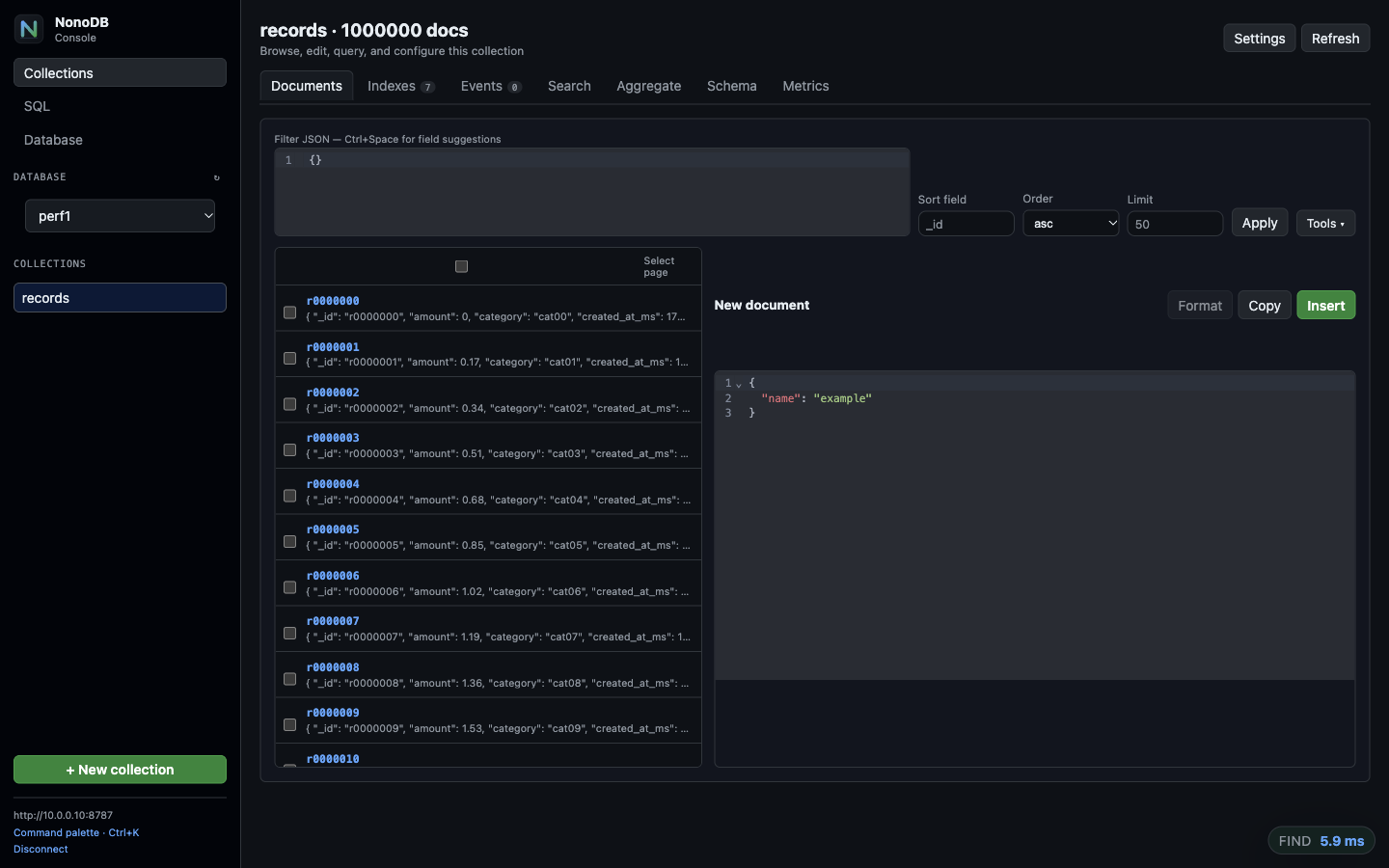
 is the all-in-one JSON document database for small VMs and edge boxes. Crash-safe storage, search, SQL, history, TTL, backups, replication, and a GUI in one binary.
$ docker compose -f deploy/docker-compose.quickstart.yml \
    --profile init run --rm auth-init

$ docker compose -f deploy/docker-compose.quickstart.yml up -d

# API on 127.0.0.1:7878
$ curl -s http://127.0.0.1:7878/healthzIncluded in the binary
Lexical text search, trigram/Levenshtein matching, and exact vector search in the same LMDB file.
SELECT, INSERT, UPDATE, DELETE, aggregates, and explain_sql alongside the document API.
Per-collection revision history with global revision IDs and configurable retention.
Whole-document encryption with per-tenant keys for the native client and HTTP path.
Collection defaults and per-document overrides, expired in the background.
Native or restic backups, gzip/age encryption, local/S3/R2 destinations, and restore drills.
Primary, replica, and standby nodes with quorum promotion, automatic election, and partition rejoin.
Browse documents, run SQL, manage indexes, backups, credentials, cluster state, and metrics.
An optional wire endpoint for official PyMongo, Node.js, and Go drivers. No MongoDB dependency.
Small footprint, real database
NonoDB keeps hot pages in the OS page cache and the daemon heap small. It runs on 512 MB–2 GB VMs, Raspberry Pi 4/5 with a 64-bit OS, and developer laptops without a separate database server.
Documentation
Run with Docker Compose, prebuilt binaries, or build from source.
Open →Every operation, filter, update, aggregation stage, and error code.
Open →The documented subset, official drivers, and known differences.
Open →Configuration, deployment, security, snapshots, monitoring, and capacity.
Open →Full-text, fuzzy, vector, indexes, and ranking behavior.
Open →Methodology, throughput, latency, memory, and large-data results.
Open →One binary. No vendor lock-in.