
Replication design
This page describes the replication design and wire model. For deployment, configuration, CLI, GUI, failover, and troubleshooting, use the Replication and cluster guide.
Replication is separate from backup and restore: backups protect against history, while replication keeps independent NonoDB nodes close to users.
- Local reads in every region.
- A simple primary → replica path first.
- A hot standby with controlled failover.
- Same ports and same GUI binary on every node.
- A role-aware GUI that clearly shows primary, replica, standby, lag, and failover state.
- Mandatory TLS 1.3 + mTLS for node-to-node replication across providers.
- Replication lag, sequence, certificate expiry, and apply failures in Prometheus and the GUI.
- No silent split-brain or last-write-wins default.
Non-goals for the first version
Section titled “Non-goals for the first version”- Full master-to-master writes to the same document.
- Tenant-aware write routing.
- CRDTs or field-level merge policies.
- Quorum payments in the initial replication slice.
- Network replication over plaintext.
Topology
Section titled “Topology”Start with:
global router / GeoDNS │ ├── primary region (all writes) ├── hot standby (sync or async) └── read replicas (local reads)Every node uses the same ports:
7878 daemon API + /v1/replication/*8787 local GUI proxyReplication is pull-based:
replica ──outbound mTLS──▶ primaryThis works across NAT and providers without requiring inbound access to every replica.
Consistency profiles
Section titled “Consistency profiles”| Data | Recommended mode | Failure behaviour |
|---|---|---|
| Profiles, content, feeds | primary + async read replicas | small RPO acceptable |
| Orders | home-region owner + one sync replica | no acknowledged write loss on single-region failure |
| Payments | leader per account/payment + quorum | reject writes without quorum; external ledger reconciliation |
The initial implementation targets the first two. Payments remain outside the first replication slice until quorum, fencing, and audit semantics are complete.
Durable replication log
Section titled “Durable replication log”The core now contains the first foundation: nonodb_core::replication.
Each database has an internal _replication LMDB sub-database. A record stores
one committed write transaction, preserving transaction grouping and the single
writer order:
{ "seq": 1042, "origin": "eu-1", "created_at_ms": 1794600000000, "changes": [ { "collection": "orders", "op": "update", "id": "o-123", "before": {"_id":"o-123","status":"pending"}, "after": {"_id":"o-123","status":"paid"} } ]}Implemented core primitives:
Store::append_replication_txn_in()Store::replication_after()Store::replication_head()Store::prune_replication_through()
The daemon writer appends ordered logical operations in the same LMDB
transaction as the data. changes carries document payloads; ops carries the
exact order of document, metadata, index, subscription, and outbox operations.
Older logs without ops still apply document changes sequentially. Vault
writes remain outside replication. Set NONODB_REPLICATION_ENABLED=1 and
NONODB_REPLICATION_ORIGIN to enable logging.
Read-only inspection endpoints:
GET /v1/replication/statusGET /v1/replication/changes?after=0&limit=100Replica apply rules
Section titled “Replica apply rules”- Apply one whole replication transaction as one local write transaction.
- Reject older
owner_epochvalues after failover. - Apply
(origin, seq)idempotently. - Preserve deletes with tombstones.
- Apply metadata and indexes at their exact position in the transaction.
- Apply replicated
_eventsoutbox documents; do not re-evaluate persistent subscriptions or generate a second set of events. - Generate local document history from the replicated
before/aftervalues when the collection history setting is active. - Notify connection-scoped live streams after commit; never write live events
into
_eventson the replica. - Build or backfill indexes on the replica after the metadata operation.
- Expose
promotion_ready; automatic election refuses to promote a candidate that has not applied the last observed source head. - Deep-verify snapshots before installing them.
Bootstrap and resync
Section titled “Bootstrap and resync”- Create a consistent snapshot with
copy_to_file. - Record the snapshot replication sequence.
- Import the snapshot into a new database.
- Start pulling changes after that sequence.
- Verify lag reaches zero.
- Only then mark the replica ready for reads.
A resync must be resumable and must not expose a half-installed database.
Transport security
Section titled “Transport security”- TLS 1.3.
- Private CA.
- One certificate per node.
- Optional client certificates for normal API traffic; required for
/v1/replication/*. - Certificate rotation and expiry monitoring.
- Firewall allow-list between known peers.
- NTP on all nodes.
- Optional WireGuard as defence in depth; not a replacement for mTLS.
The replication identity is a node certificate, not a shared bearer token.
GUI behaviour
Section titled “GUI behaviour”The same GUI runs on every node and reads:
GET /v1/replication/statusPrimary:
[ PRIMARY ] eu-1 · writes enabled · 2 replicas connectedmax lag 0.4 s · last seq 10,422Replica:
[ REPLICA ] us-1 · read-only · source eu-1 · lag 0.8 slast applied seq 10,418The GUI disables normal write controls on a replica and exposes replication actions to administrators:
- add peer,
- test connection,
- pause/resume,
- resync,
- promote standby,
- demote primary.
Promote/demote require explicit confirmation and an audit entry. Private keys are referenced by daemon/container paths and are never uploaded through the browser.
Monitoring
Section titled “Monitoring”Prometheus metrics are exposed at /metrics/prometheus with a metrics:read,
admin:db, or *:* token. JSON metrics are available at /metrics.
nonodb_replication_enablednonodb_replication_role{role="primary|replica|standby"}nonodb_replication_epochnonodb_replication_origin_info{origin="..."}nonodb_replication_head{database="..."}nonodb_replication_applied{database="...",origin="..."}nonodb_replication_applied_epoch{database="...",origin="..."}nonodb_replication_lag{database="...",origin="..."}nonodb_replication_ack_nodes{database="...",origin="..."}nonodb_replication_min_ack{database="...",origin="..."}nonodb_replication_ack_seq{database="...",origin="...",node="..."}nonodb_replication_ack_age_seconds{database="...",origin="...",node="..."}nonodb_replication_transport_errors_totalnonodb_replication_apply_errors_totalnonodb_replication_applied_totalnonodb_replication_pruned_totalnonodb_replication_retention_runs_totalAlerts:
- peer disconnected,
- lag above policy,
- stalled applied sequence,
- apply error growth,
- certificate expiring,
- no standby,
- failover,
- replication log disk pressure.
/readyz will be role-aware: a replica is not ready for reads while
bootstrapping or above its allowed lag threshold; a primary is not ready for
writes without the required standby/quorum.
Current pull replica
Section titled “Current pull replica”A node with NONODB_REPLICATION_ROLE=replica or standby rejects client writes
and pulls from NONODB_REPLICATION_SOURCE:
GET /v1/replication/statusGET /v1/replication/changes?after=N&limit=500NONODB_REPLICATION_SOURCE_TOKEN is optional when the source authenticates the
client certificate. NONODB_REPLICATION_CA_FILE,
NONODB_REPLICATION_CERT_FILE, and NONODB_REPLICATION_KEY_FILE enable mTLS.
Apply is atomic per source transaction and idempotent for the global source
sequence. Replicas append each applied transaction to their own local log, so a
promoted replica can serve downstream replicas. The local log sequence matches
the source sequence. A gap returns an error instead of skipping transactions.
Apply invalidates the replica query cache, and transport/apply failures are
counted and exposed through status/GUI. /readyz reports the role and does not
require the writer on a read-only replica.
A promoted replica that should act as a source for other replicas must have
NONODB_REPLICATION_ENABLED=1 so new local writes are captured. Mixed origins
are supported by the global applied sequence; epochs are tracked per origin.
Before the daemon opens its runtime, a fresh replica can install a consistent source snapshot:
GET /v1/replication/snapshotPOST /v1/replication/prune {"through": N}Replicas acknowledge the applied sequence to the source after each successful batch. The source records acks per node and origin. Prune can require them:
POST /v1/replication/prune{"through": 1234, "require_acks": true}The effective prune point is capped at the minimum acknowledged replica
sequence. Replicas refresh their acknowledgement while idle, so
ack_age_seconds reflects liveness rather than just write activity. If no replica has acknowledged the source, the request fails with
no_replica_acks. Set NONODB_REPLICATION_NODE_ID on every replica so acks are
distinguishable.
Automatic retention is opt-in:
NONODB_REPLICATION_PRUNE_INTERVAL=60NONODB_REPLICATION_RETENTION_KEEP=0Every interval the primary prunes through min_ack - keep, but never beyond
the current log head. With no replica acks nothing is pruned. Set keep above
zero for a safety margin.
NONODB_REPLICATION_BOOTSTRAP=auto installs a snapshot when the local database
is fresh, or when the source log no longer contains the next sequence the
replica needs. always installs one on every start; never disables bootstrap.
The snapshot’s own replication head becomes the initial applied sequence, so
changes after that point are pulled normally.
The gap check runs at startup, before the runtime opens. A pruned source log
therefore installs a fresh snapshot on the next start. If a gap appears while
the daemon is running, the pull loop reports an error. With
NONODB_REPLICATION_EXIT_ON_GAP=1 it also requests a graceful shutdown; a
supervisor such as systemd, Docker, or Kubernetes restarts the replica and the
startup gap check installs a fresh snapshot. Without a supervisor, restart the
replica manually.
A different failure, a sequence mismatch or stale epoch, means the local replication log diverged from the source. The replica then performs an in-place hard resync: it recreates the affected database and pulls the source log again without restarting the process. This is not a zero-downtime snapshot restore; serving reads pause while the database is reset. A hot snapshot resync while the daemon keeps serving reads is still future work.
Changing the source
Section titled “Changing the source”The active pull source is reloaded from the hidden node metadata collection
<NONODB_DATA>/.node on every loop. Update it without restarting:
PUT /v1/replication/source{ "source": "https://new-primary:7878", "databases": ["default", "app1"], "interval_secs": 1, "bootstrap": "auto"}Env values seed a new installation; the persisted source wins afterwards.
Role, source, vote, lease, and peer-token state live in the hidden LMDB
collection <NONODB_DATA>/.node; legacy JSON files are migrated once. Token,
CA, client certificate, and key remain environment settings. If the source is
unreachable, the replica queries NONODB_REPLICATION_SEEDS, voters, and
followers at /v1/replication/primary and switches to the reported primary. The new source
must expose a compatible sequence/epoch stream, or the replica must be restarted
so startup bootstrap can install a fresh snapshot.
Write routing
Section titled “Write routing”GET /v1/replication/primary returns the best-known write endpoint:
{ "role": "replica", "epoch": 2, "write_url": "https://new-primary:7878"}The same value is exposed as write_url in replication status and
/readyz.replication.write_url. A load balancer or client can poll a stable
node and route writes to this URL. The endpoint requires admin:db; /readyz
is unauthenticated for lightweight health routing.
For write pools, use:
GET /readyz/writeIt returns 200 only on a writable primary. A replica returns 503 and sets
Location to the known primary URL. A write request that reaches a replica and
fails with read_only also includes the same Location header and
error.write_url in the response body, so clients and proxies can retry against
the current primary. The official clients support write_url/auto_primary for
this; see Clients. For example, an
HAProxy backend check can
use option httpchk GET /readyz/write with http-check expect status 200, so
only the current primary is selected for writes.
Manual role changes
Section titled “Manual role changes”Roles are persisted in the hidden node metadata collection
<NONODB_DATA>/.node. The env var seeds a new installation; after that the
persisted role wins.
POST /v1/replication/promote {"expected_epoch": 0}POST /v1/replication/demote {"expected_epoch": 1, "role": "replica"}Each successful change increments epoch. A stale expected_epoch returns
409 to prevent an operator acting on outdated role information. Promotion
stops the replica pull loop and enables the writer. Demotion makes the node
read-only again.
When NONODB_REPLICATION_VOTERS is set, promotion first requests votes from a
majority of the configured voter URLs:
NONODB_REPLICATION_VOTERS=https://eu-1:7878,https://eu-2:7878,https://eu-3:7878NONODB_REPLICATION_VOTER_TOKEN=<shared-admin-token>Each voter persists the highest granted (epoch, candidate) in the hidden node
metadata collection; conflicting candidates at the same epoch are rejected.
Promotion fails with quorum_not_reached without a majority.
A primary with voters configured renews a lease every
NONODB_REPLICATION_LEASE_INTERVAL seconds. Voters persist the lease in the
hidden node metadata collection. If the primary cannot reach a majority for
NONODB_REPLICATION_LEASE_TTL seconds, it self-demotes to replica and stops
accepting writes. This fences an old primary that is partitioned from the
quorum.
Automatic election is opt-in on selected replicas:
NONODB_REPLICATION_AUTO_FAILOVER=1NONODB_REPLICATION_CANDIDATE=1NONODB_REPLICATION_CANDIDATE_PRIORITY=0NONODB_REPLICATION_ELECTION_INTERVAL=5NONODB_REPLICATION_FAILOVER_TIMEOUT=30NONODB_REPLICATION_ADVERTISE_URL=https://eu-2:7878After the source has been unavailable for the timeout, a candidate calls the
same quorum/fence promotion path. Voters reject a second candidate at the same
epoch, so only one candidate can obtain a majority. Set the candidate flag only
on replicas that should be allowed to lead. Lower
NONODB_REPLICATION_CANDIDATE_PRIORITY values campaign earlier; quorum voting
still ensures that only one candidate at a given epoch can win. After a
successful promotion, the
new primary pushes itself as the configured source to every voter URL and every
URL in NONODB_REPLICATION_FOLLOWERS, so both groups reload their pull source
automatically. Followers do not vote, so use them for read replicas that must
not participate in quorum decisions.
When NONODB_REPLICATION_ADVERTISE_URL is set, promotion then asks the current
source to demote itself with this node as successor. The promotion is aborted
if that fence request fails; use "force": true (CLI --force) only when the
old primary is unreachable and you accept the split-brain risk. force does not
bypass quorum voting.
Demote accepts an optional successor URL:
POST /v1/replication/demote{"expected_epoch": 2, "role": "replica", "successor": "https://new-primary:7878"}Replicas pulling from a non-primary source with a successor automatically persist that successor as their new source and reload the pull loop. Promotion clears the successor.
This is manual promotion, not quorum failover. The old primary must be demoted or stopped to avoid split-brain.
Replication transactions carry the writer’s role epoch. A replica records the
highest applied epoch per origin and rejects any transaction from an older
epoch with stale replication epoch. Promoting a source therefore fences
replicas against transactions produced before the promotion, as long as they
pull from the demoted node under the same origin.
Lease-gated writes, quorum promotion, leases, candidate election, and the cluster control plane are implemented. See the replication and cluster guide for operation.
Cluster control plane
Section titled “Cluster control plane”The current primary publishes one hidden __nonodb_control document through the
normal durable replication log. It contains:
- the auth registry snapshot (principals, scopes, token hashes, certificate fingerprints);
- backup job definitions and run state;
- the non-default database catalog;
- the cluster peer token used for cross-node source/vote authentication.
Replicas apply the snapshot immediately, so every node has the same admin credentials and configuration. Write-side owners — TTL sweeper, history pruning, subscription evaluation, automatic events, backup scheduler, retention, and maintenance — only run while the node is a writable primary.
Promotion readiness requires both the data head and the control-plane snapshot. A candidate that is behind either one refuses automatic promotion.
The cluster peer token is stored in the control document and in the hidden
local metadata collection <NONODB_DATA>/.node. This is a deliberate cluster-wide
administration model: every fully joined node can become primary and has the
credentials needed to accept clients and follow the next primary.
Database create/drop is part of the catalog. Replicas create missing databases
and, by default, drop databases that disappear from the catalog. Set
NONODB_CLUSTER_PRUNE_DATABASES=0 to keep removed local databases.
Vault payloads are replicated as encrypted envelopes. Tenant keys are client-supplied and remain outside the control plane.
Implementation phases
Section titled “Implementation phases”Phase 1 — log and status
Section titled “Phase 1 — log and status”- Core replication record and
_replicationsub-database. - Append/read/prune core primitives and tests.
- Writer integration for normal CRUD, atomic write batches, and TTL expiry.
- Durable transaction sequence per database.
- Read-only replication status and changes endpoints.
- Writer replication integration test.
- SQL write capture.
- Vault encrypted-envelope write capture.
- Role, capture, origin, and head metrics.
- Applied sequence and lag metrics.
- Transport and apply-error counters.
- Cache invalidation after replica apply.
Phase 2 — primary → replica
Section titled “Phase 2 — primary → replica”- Pull transport with HTTP, optional TLS, and optional client mTLS.
- Apply path with per-origin
(origin, seq)idempotence. - Read-only replica write gating.
- Applied sequence and lag status/metrics.
- Snapshot bootstrap with recorded sequence.
- Replicas keep a local log of applied transactions for promotion.
- Global applied sequence supports mixed origins.
- Epoch fencing and source changes.
- Automatic snapshot resync at startup when the source log was pruned too far.
- Graceful restart on a runtime gap when
NONODB_REPLICATION_EXIT_ON_GAP=1. - In-place hard resync when the local log diverges from the source.
- Hot snapshot resync while the daemon keeps serving reads.
- Replica readiness policy includes data and control-plane head.
Phase 3 — operations and GUI
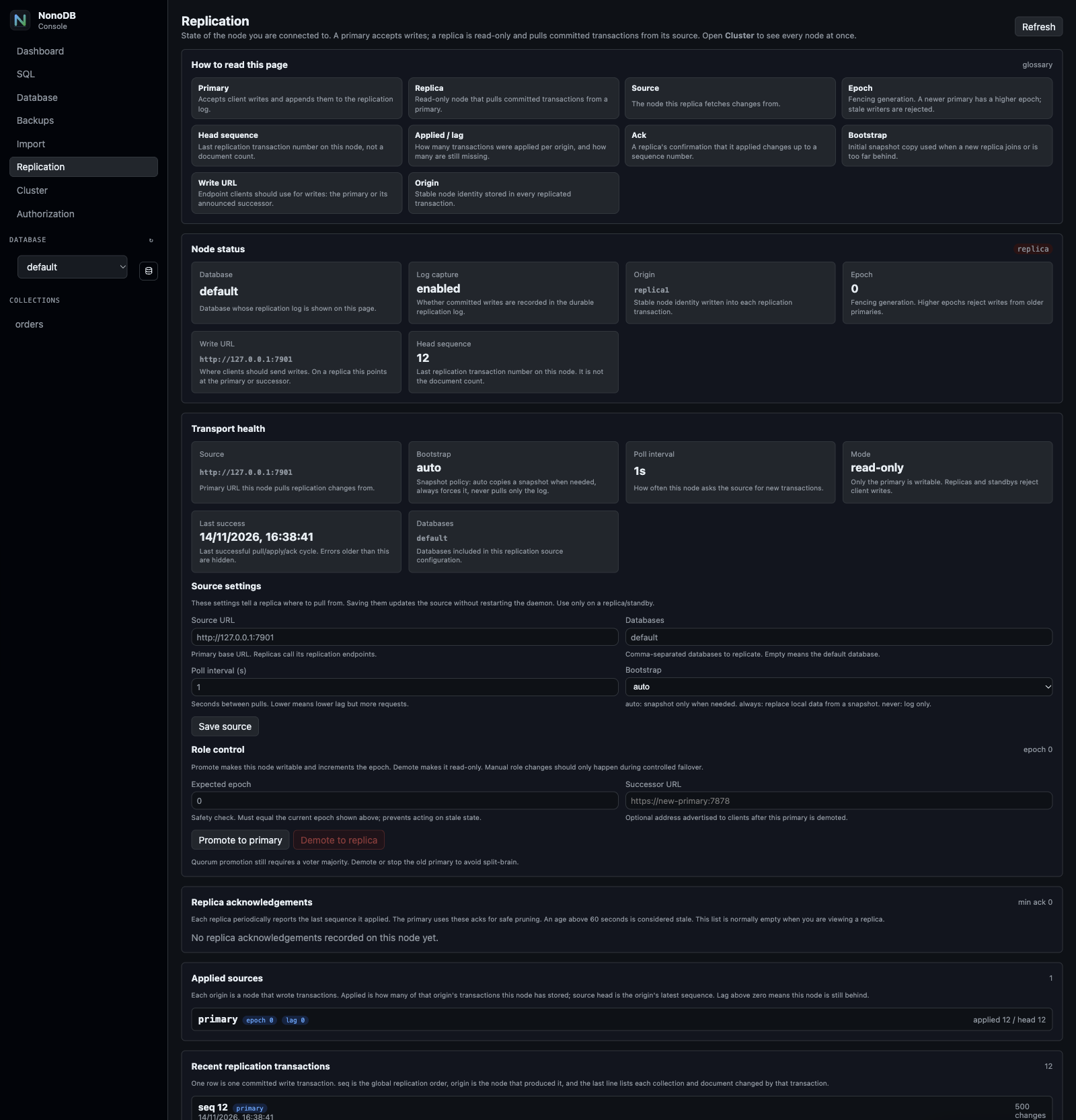
Section titled “Phase 3 — operations and GUI”- Replication tab with role, source, bootstrap, applied/lag, transport health, and recent log entries.
- Role-aware
/readyzandnonodb-cli replicationstatus/changes/prune. - Peer wizard with one-time pairing codes and full role banner.
- Persist and reload the pull source without restart.
- Add peer pairing, revoke, source validation, and control-plane snapshot.
- Pause/resume/disconnect controls and in-place hard resync.
- Manual promote/demote with persisted role, expected epoch, and audit.
- Promotion/demote confirmation workflow in the GUI.
- Certificate expiry and lag dashboards.
- Alert rules.
Phase 4 — failover and stronger policies
Section titled “Phase 4 — failover and stronger policies”- Lease-based promotion and lease-gated writes.
- Fencing epochs.
- Synchronous quorum writes / zero-RPO standby.
- Per-collection consistency profiles.
- Quorum payments design.
Open questions
Section titled “Open questions”- Which writer operations are replicated: document writes only, or also indexes, TTL, history, and collection settings?
- Do replicas generate local history/events, or receive them?
- How long are tombstones and replication records retained?
- Should the replication API be on the same listener or a dedicated port?
- How are vault collections keyed across regions?
The GUI Replication tab explains the role, epoch, source, bootstrap, lag,
applied positions, acknowledgements, and write routing for the connected node.
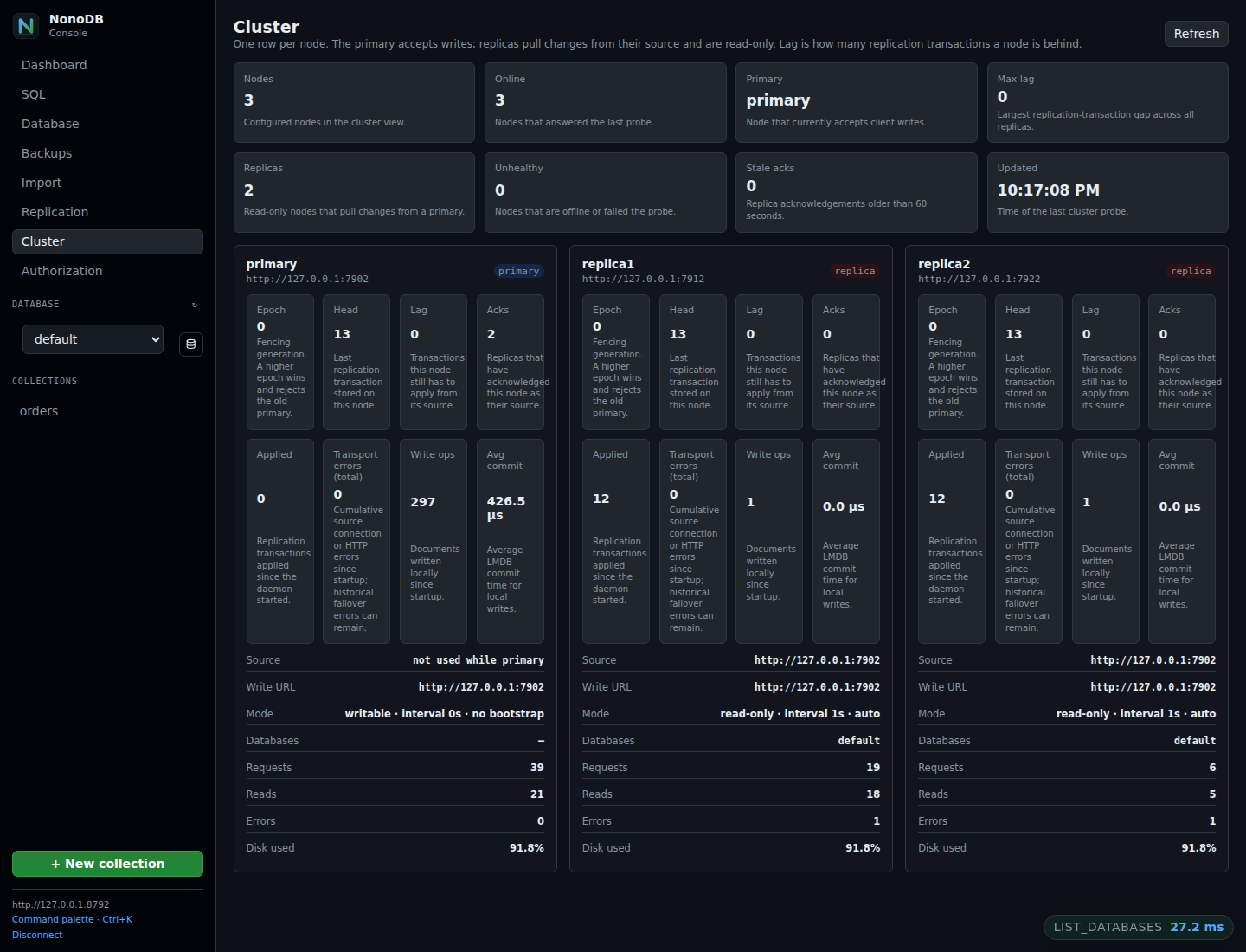
The Cluster tab probes every node listed with --cluster and shows the
whole topology, including offline members.
Events, watch, and streams during replication
Section titled “Events, watch, and streams during replication”There are three different mechanisms:
- Replication log — every committed write is appended as an ordered set of logical operations: document changes, collection metadata, indexes, subscriptions, and outbox events.
- Application events — when enabled, the primary writes event documents to
_events. Those documents are replicated asevent_appendoperations in the same transaction. Subscription definitions are replicated as metadata. - Watch/streams — long-poll
watch, NDJSON, and SSE read replicated_events; connection-scopedmode:"live"notifications are dispatched by the replica apply path after commit.
On a replica:
- replicated writes produce the same
_eventsdocuments as the primary; - long-poll
watchon_eventssees replicated events; - live
/v1/watch, NDJSON, and SSE receive replicated document changes; - persistent subscriptions are not re-evaluated on the replica, avoiding duplicate outbox events; they remain active for when the node is promoted;
- the local replication log is still available at
GET /v1/replication/changesfor checkpoint-based consumers.
Replica feature support
Section titled “Replica feature support”The replica remains intentionally read-only for clients. Reads and administrative
inspection work; client writes are rejected with read_only.
| Feature | On a replica | Notes |
|---|---|---|
find, find_one, count, aggregate, SQL SELECT |
Yes | Replicated documents are readable. |
insert, update, delete, batch, SQL writes, import |
No | Rejected with HTTP 403 read_only. |
Primary _id lookup |
Yes | _id is built into every collection. |
| Collection creation, TTL, history, event settings | Yes | Replicated as ordered metadata operations. |
| Secondary, text, fuzzy, vector, geo indexes | Yes | Created and backfilled on the replica; subsequent applies maintain them. |
| Unique index enforcement | Yes | The definition is replicated, so a promoted replica keeps enforcing it. |
| TTL | Config replicated | Expiry runs on the primary and is replicated as a delete. The replica does not run a local TTL sweeper; after promotion the TTL setting is already present. |
| Document history | Yes | Generated locally from replicated before/after values and the replicated history setting. History pruning is paused while read-only and resumes after promotion. |
| Automatic collection events | Yes | _events documents are replicated atomically with the source transaction. |
| Conditional subscriptions | Yes | Definitions and renewals are replicated; evaluation happens only on the primary. |
Long-poll watch on _events |
Yes | Replicated outbox documents are readable. |
Live /v1/watch, NDJSON, SSE, thresholds |
Yes | Apply dispatches local live notifications after commit. |
| Background jobs / workers | Must target primary | Workers claim jobs with writes; a replica rejects the claim. |
| Backup, verify, export | Yes | Read-only operations over local database files. |
| Metrics, readiness, GUI monitoring | Yes | Metrics and the Replication/Cluster tabs work on replicas. |
| GUI data editing, imports, role-independent writes | No | The same read_only gate applies. |
| Multi-database reads | Yes | The replicated catalog adds databases to the source list automatically; explicit NONODB_REPLICATION_DATABASES is a seed. |
| Auth registry, admin tokens, certificates | Yes | Replicated as hashes/fingerprints on every node; the same client token works after promotion. |
| Backup jobs and run state | Yes | Replicated; only the primary runs the scheduler. |
| Database catalog | Yes | Create/drop replicated; local databases follow the catalog. |
| Vault payloads | Yes | Encrypted envelopes are replicated; the tenant key remains client-side. |
| Vault keys | No | Never stored by NonoDB. |
| Replication status/changes/acks/promote/demote APIs | Yes | Administrative endpoints remain available on replicas. |
Metadata and outbox operations are idempotent through the applied sequence. A replica that joins by snapshot receives all metadata present in that snapshot; metadata created later arrives through the operation log.
Configuring and monitoring with the CLI
Section titled “Configuring and monitoring with the CLI”Runtime source and role operations:
nonodb-cli replication statusnonodb-cli replication primarynonodb-cli replication changes 0 100nonodb-cli replication acksnonodb-cli replication source http://primary:7878 default 1nonodb-cli replication promote <epoch>nonodb-cli replication demote <epoch> replica [successor-url]nonodb-cli replication prune <seq> --require-acksThe CLI can change the pull source, inspect lag/applied sources/acks, prune the
log, and perform manual promotion or demotion. Cluster identity, TLS paths,
voters, followers, leases, election timing, retention, and bootstrap defaults are
configured with NONODB_REPLICATION_* environment variables at daemon start;
the CLI does not expose commands for those settings. The GUI adds live cluster
probing, progress, and per-node role/source controls, but not full environment
management.
Multi-host validation
Section titled “Multi-host validation”scripts/replication_cluster_test.py runs a five-host cluster with continuous
writes while replicas join dynamically. It verifies snapshot catch-up, replica
acks, quorum election, source propagation to voters and followers, and that all
nodes converge after the primary is stopped.
scripts/replication_load_test.py runs a seven-host, one-million-document load
with six nodes joining during the load, eight concurrent writers, and two
quorum failovers. It also enforces memory limits and uses small replication
batches so a large transaction does not create an unbounded /changes
response.
Replicas advance their persisted role epoch when they observe a newer epoch in the applied stream. This is required for a second failover: the next candidate proposes an epoch above the votes cast for the previous primary.
replication status also exposes promotion_ready. Automatic election requires
the candidate to have applied the last observed source head; a lagging candidate
waits instead of promoting stale data. Manual promote --force remains an
explicit operator override.